On the day
The Osaka sumo show, part by part
The five parts of the studio show as the booking page lists them, what each one is in sumo terms, and what the page does not promise.
Book the sumo show ↗Quick answer
The booking page names five parts: history and rituals, a training demonstration, famous techniques, a one-round match and a ring challenge. An English-speaking MC links them over roughly 90 minutes. The order and details can vary, and the listing gives no running times, so treat the list as the shape of the visit, not a script.
The short answer
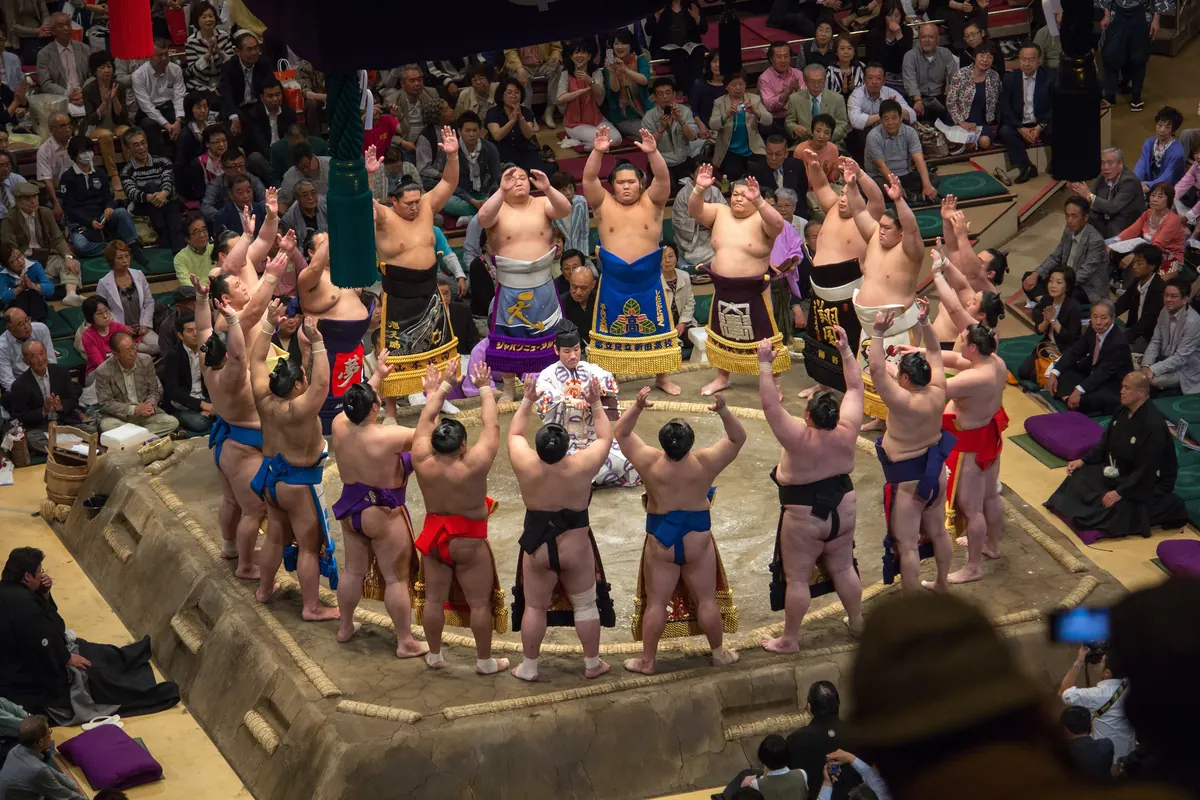
The visit has five parts, in the order the booking page gives them: history and rituals, training, famous techniques, a one-round match and a ring challenge. An English-speaking MC explains as it goes. The listing does not give timings for each part, the number of wrestlers or a fixed order, so use this as the shape of the hour and a half rather than a promise.
Part one: history and rituals
Wikipedia traces sumo back many centuries and notes that it keeps ritual elements from Shinto, including salt purification. The listing promises an introduction to history, sacred rituals and signature techniques. For a first-timer this is where the MC matters most, because the gestures that look odd, such as throwing salt, make sense once someone explains what they are for.
Part two: training
The listing includes training routines. Wikipedia describes stable life as built around early training, and its glossary describes shiko, the leg-raising stomp repeated many times. A studio demonstration is a short version of that world. The booking page does not name the exercises or say how long this part runs, so do not expect a full practice session.
Part three: famous techniques
A technique that wins a bout is a kimarite. Wikipedia lists the most common as pushing the opponent out with the arms, oshidashi, and gripping the belt to force him out, yorikiri, which it calls the most common winning technique in professional sumo. The listing says you see famous techniques but does not say which ones, and the Japan Sumo Association recognises 82 in all.
Part four: the one-round match
The listing describes a single-bout match, a tachiai, between retired wrestlers. The word names the initial charge, which Wikipedia says comes from Japanese words for stand and meet. In a tournament, bouts are usually over in seconds. The listing does not say how long the show bout lasts, so expect something short and decisive, and judge it as a demonstration of the charge and the winning technique.
Part five: the ring challenge
Guests who wish can go into the ring against a wrestler. The listing says spots are limited and does not say how many, or how places are given out. People who stay seated still see the other four parts. Check the booking page's details before you plan around a turn, and treat the challenge as a possible extra, not part of the ticket's promise.
What the booking page does not say
The listing gives no running order, no number of wrestlers, no ring size and no length for each part. It does not say whether children can take part in the challenge. Where this guide gives sumo background, it comes from Wikipedia and the Japan Sumo Association's pages, not from the show itself, so the background may be fuller than what you see in the studio.
How it differs from a tournament day
At a Grand Tournament a day begins with the lowest divisions and ends with the highest-ranked wrestlers, according to Wikipedia, and every ranked wrestler has a bout daily across fifteen days. The studio show compresses sumo into one hosted visit with an explanation. It is a way to learn what you would be watching, which makes a later tournament easier to follow, but it is not a substitute for one.
Booking
Open the calendar on the booking page for starting times. The listing offers free cancellation until 24 hours beforehand and reserve now, pay later. The show is 1.5 hours long, with an English-speaking MC, and the venue is wheelchair accessible. The meeting point is the AI Building, Asahi 1-5-1, in Nishinari Ward, so check the map on your confirmation.
Frequently asked questions
What happens at the Osaka sumo show?
The listing names history and rituals, a training demonstration, famous techniques, a one-round match and a ring challenge, led by an English-speaking MC over about 1.5 hours.
How long is each part?
The listing gives no length for each part, only the 1.5-hour total. Check the booking calendar for starting times.
Does the show use the same rules as a tournament?
The listing does not say. It describes a single-bout match between retired wrestlers, whereas a tournament runs fifteen days with rankings at stake.
Which techniques will I see?
The listing says famous techniques, called kimarite, without naming them. The Japan Sumo Association recognises 82, though only about a dozen are common.
Sources