Start here
Are Osaka sumo shows real sumo?
What a retired-wrestler show in Nishinari is, how it differs from a Grand Tournament, who it suits, and which kind of sumo outing to book in Osaka.
Book the sumo show ↗Quick answer
The wrestlers are real and retired, and the techniques are real, but the Osaka studio show is entertainment, not a tournament. The listing describes an English-led hour and a half of sumo history and rituals, a training demonstration, famous techniques, a one-round match and a ring challenge for a few guests. Ranked bouts belong to the six Grand Tournaments each year, and Osaka's is in March. Pick the show to understand sumo, and a tournament to watch it decided.
The short answer
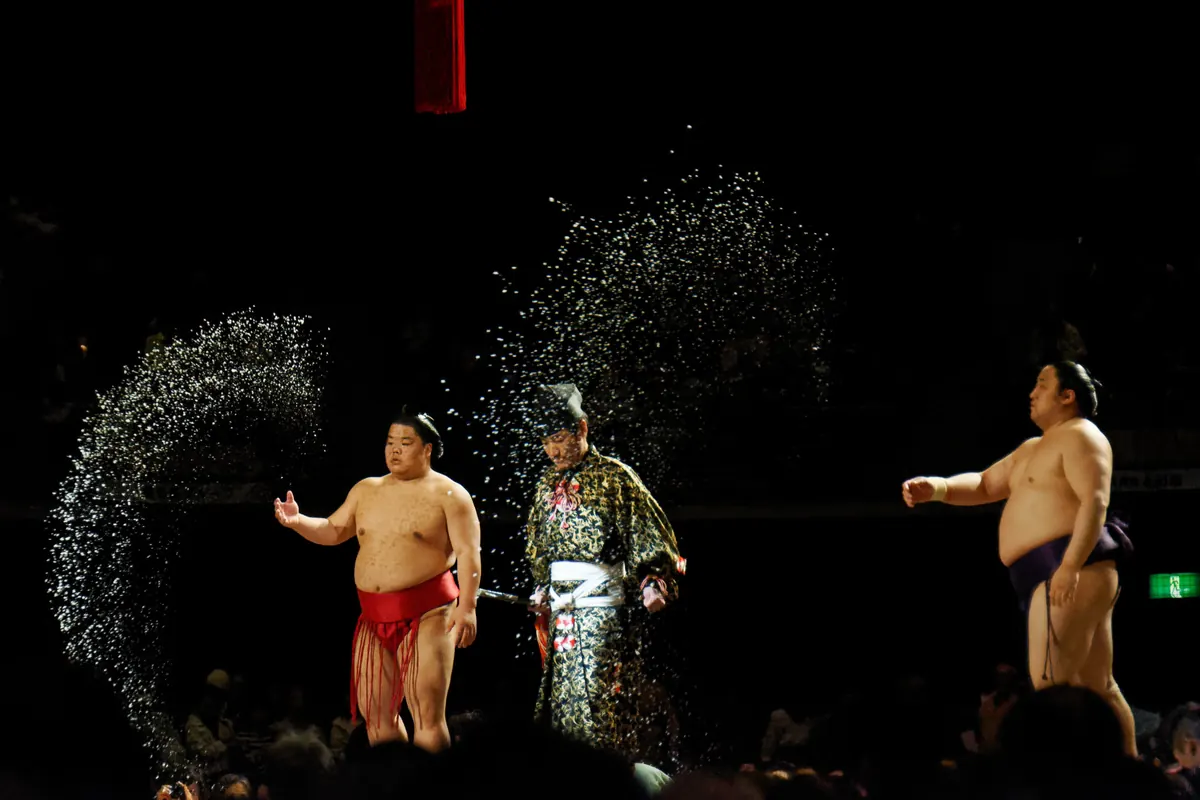
The wrestlers are real and retired, the techniques are real, and the format is a show. The booking page for the Nishinari studio calls it an entertainment show performed by retired wrestlers: a talk on sumo's history and rituals, a training demonstration, famous techniques, a one-round match and a ring challenge for a few guests. It is not a ranked tournament bout, and it is not a visit to a working stable. Choose it if you want to understand sumo up close. Choose a March tournament if you want the competition itself.
What the listing says you get
The listing names five parts: sumo's history, sacred rituals and signature techniques; a demonstration of training; famous techniques called kimarite; a one-round match called a tachiai between retired wrestlers; and a chance for guests who wish to go into the ring against one of the wrestlers. The booking page adds an English-speaking MC and a running time of 1.5 hours, and says the venue is wheelchair accessible. It does not say which wrestlers perform or what ranks they once held, so this guide does not either.
What a Grand Tournament is
Competitive sumo runs on six Grand Tournaments, called honbasho, each year. Wikipedia says three are held in Tokyo and one each in Osaka, Nagoya and Fukuoka. A tournament lasts 15 days, opening on a Sunday and closing on the Sunday two weeks on, and the wrestlers of the top two divisions have a bout every day. Results decide who moves up or down the ranking list. That pressure is what a studio show cannot reproduce: nobody on a show stage is fighting for promotion.
When Osaka hosts the real thing
The Japan Sumo Association's schedule page names the March Tournament at EDION Arena Osaka, which is also known as the Osaka Prefectural Gymnasium, and Wikipedia places that arena in Namba. It is its own event, ticketed separately, and no part of the show covered here. Outside March, a show is the practical way to watch wrestlers at work in Osaka. If your trip falls in March, check the association's schedule page for exact dates before you plan around them.
Read next: The Osaka Grand Tournament in March
What a retired wrestler is
A retired wrestler is a former competitor who has left the ranks. Wikipedia explains that only some stay in the sumo world: a former wrestler who reached a high enough rank, or held a ranking in the top two divisions for long enough, can inherit one of 105 elder shares, which allows him to help run the association and train new wrestlers. Others stay on as contract staff or leave sumo. The listing says only that the performers are retired, so treat that single word as the whole claim.
The ring and its rituals
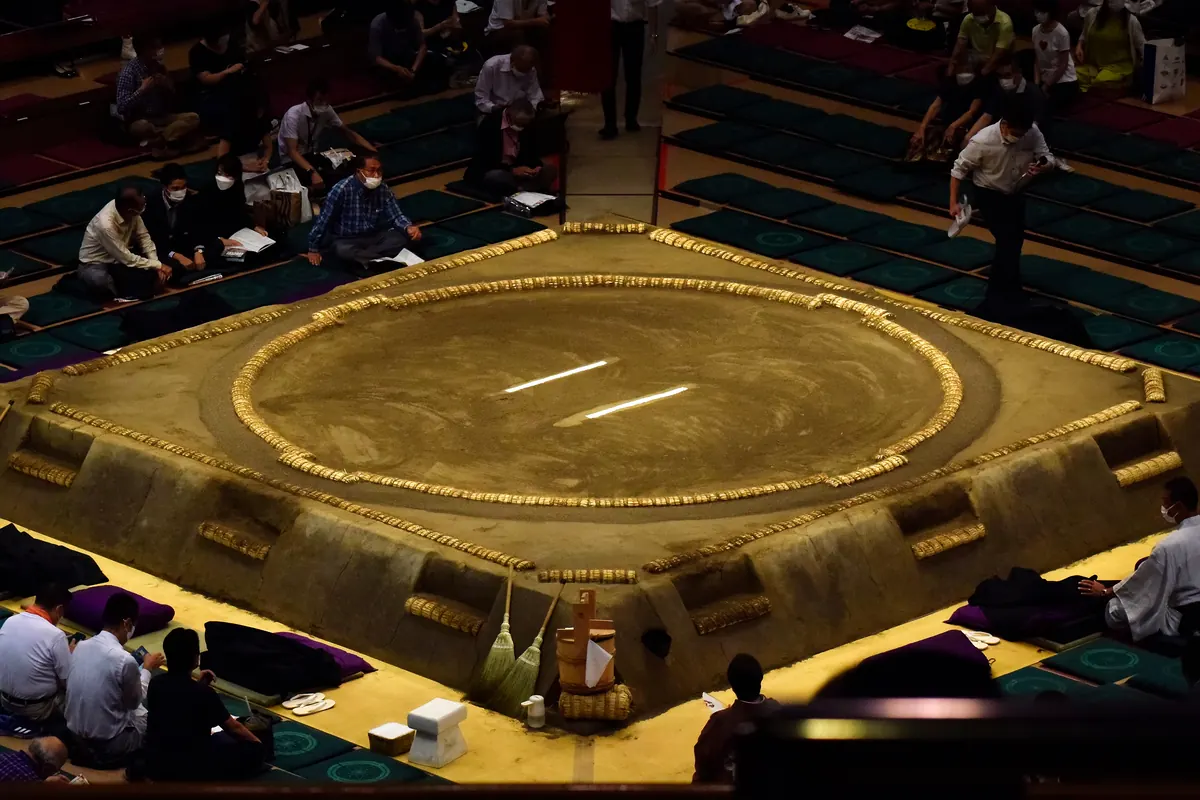
The ring is the dohyo. In professional sumo it is a circle 4.55 metres across, marked by partly buried rice-straw bales, on a raised platform of clay covered in sand, Wikipedia says. Rituals surround it. Salt is thrown in as a symbolic cleansing, and wrestlers rinse the mouth with chikara-mizu, power water, in a way that echoes the rite before entering a Shinto shrine. The listing promises sacred rituals and an MC to explain them. It does not list which ones the show performs, or describe the studio's own ring.
Shiko, the stomp
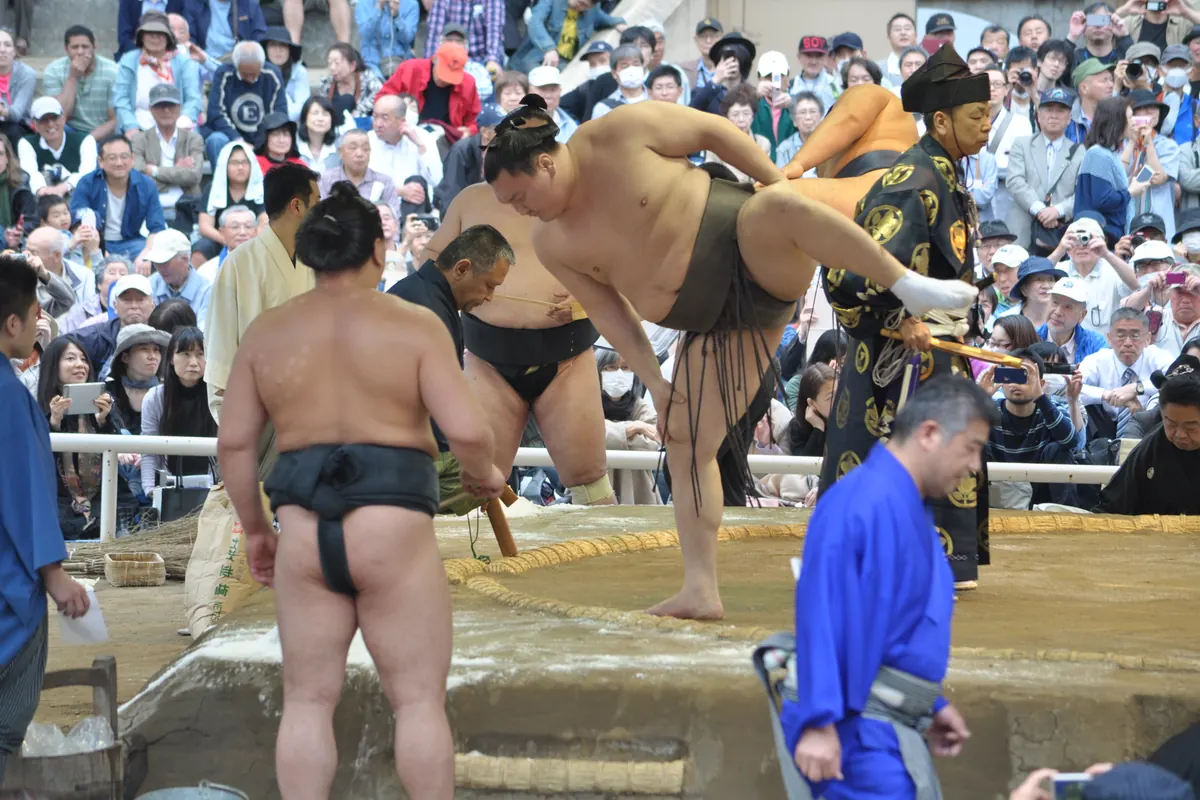
Shiko is the leg-raising stomp most people picture. Wikipedia's glossary describes an exercise where each leg in turn is raised, kept straight and stamped down hard, repeated hundreds of times in training. The glossary adds that it is a ritual too, meant to drive off demons ahead of a bout. If the training demonstration includes it, the thump of the foot is the sound that goes with sumo. The listing mentions training routines but does not name the exercises.
Kimarite and the one-round bout
A bout is decided when one wrestler is forced out of the ring, or touches down with any part of himself other than the bottoms of his feet. The winning technique is called a kimarite, and the Japan Sumo Association recognises 82 of them, though only about a dozen are used often, Wikipedia says. The one-round match in the listing begins as every bout does, with the tachiai, the initial charge. In a top-division tournament most bouts are over in seconds. The listing gives no length for the show bout.
The audience challenge
A few guests who wish to can go into the ring against a wrestler. The listing says places are limited and does not say how they are given out, so do not book on the assumption of a turn. The show works for people who stay seated: the same rituals, demonstration and bout happen either way, and the listing says it suits fans and complete beginners. If you do go in, you will face someone much heavier, because Wikipedia notes that professional sumo has no weight divisions.
Which sumo outing to book
Osaka offers four kinds of sumo outing. The Nishinari studio show is the one this site covers. A show in Namba Parks comes with a bento or snack and different terms, and the second guide compares the two. Another Nishinari show lists ex-pro wrestlers and a ring challenge. The March Grand Tournament is the competition itself. If you want a short, flexible first look, start with a studio show. If you want a meal built in, compare the Namba Parks one.
Read next: A Nishinari studio show or the Hirakuza show with bento?
Stable visits are a Tokyo thing
The listing says visits to active sumo stables are a Tokyo matter, and Wikipedia agrees in outline. Most stable buildings stand in Ryogoku, in Sumida, Tokyo, and many stables let visitors watch training, with rules that differ from one to the next. When the stables travel for the Osaka tournament they set up temporary bases, often in shrine grounds or community centres. A show is not a substitute for morning practice, and morning practice is not a substitute for a show.
How to follow a bout
A first-timer can follow a bout with three ideas. Watch the charge, because the tachiai often decides who has the advantage. Watch the hands: Wikipedia describes one style built on gripping the belt and forcing the opponent out, and another built on pushing him out without a firm grip. And watch the edge of the ring, since stepping out loses. Wikipedia adds that there are no weight divisions, so a smaller wrestler with better technique can beat a much larger one.
Why a show can still be worth it
A show can do things a tournament seat cannot. It explains each ritual as it happens, in English, to an audience of beginners, and it puts you close to the ring in a studio. It also fits any month, whereas a Grand Tournament in Osaka happens once a year. Someone who later watches a tournament will already know what the rituals are called, because the show has named them. None of this is a claim about quality, only about purpose.
Questions to settle before you book
Four questions decide most bookings. Do you want ranked competition, or an introduction? Do you need to be able to cancel? Is a meal part of what you want? And do you mind being in Nishinari rather than Namba? The answers point to a tournament, the studio show, the Namba Parks show or a Tokyo stable visit. The second guide on this site compares the two shows in detail, and the March guide covers the tournament.
Read next: A Nishinari studio show or the Hirakuza show with bento?
Who this isn't for
Skip the studio show if you want ranked, competitive bouts: that means a tournament. Skip it if you want a stable's morning practice, which belongs to Tokyo. Skip it if you must have a turn in the ring, because places are limited. Skip it if you want a long contest, since the listing describes a single-bout match rather than a card of fights. And if you want to stay in Namba, look at the show in Namba Parks, because this one is in Nishinari.
Who it suits
The listing says the show suits fans and complete beginners. It fits visitors who want the vocabulary explained in English, first-timers who have never seen a bout, and groups with mixed interests, since people can watch or take part. Visitors who need level access are covered too, since the listing calls the venue wheelchair accessible. It is a show in a studio, so expect a hosted hour and a half rather than a stadium atmosphere.
Where it is and how to book
The meeting point on the listing is the AI Building, Asahi 1-5-1, in Nishinari Ward, in the south of Osaka, not in Namba. Open the calendar on the booking page to see starting times. The listing lets you cancel free of charge until 24 hours beforehand, and you can reserve now and pay later. The show lasts about 90 minutes, led by an English-speaking MC. Check the map on your confirmation before you set out.
Frequently asked questions
Are Osaka sumo shows real sumo?
The wrestlers are real and retired, but the show is entertainment, not a tournament. The listing describes a demonstration, a one-round match and a ring challenge, with an English-speaking MC.
Is the show a tournament?
No. Tournaments are the six Grand Tournaments each year. Osaka's is in March at EDION Arena Osaka, in Namba, and it is a different event, ticketed separately.
Can I fight a sumo wrestler at the show?
A few guests can, but the listing says places are limited. It does not say how they are chosen, so do not book on the promise of a turn.
Can I visit a sumo stable in Osaka?
The listing says active stable visits are a Tokyo matter. Wikipedia says most stables stand in Ryogoku, Tokyo, and travel to temporary bases for out-of-town tournaments.
Is the show in Namba?
No. The meeting point is the AI Building, Asahi 1-5-1, in Nishinari Ward, south of the Namba area. The Namba Parks show is a different one.
Is the venue wheelchair accessible?
The listing says yes. It also gives an English-speaking MC and a running time of 1.5 hours.
Sources